
Student Wellbeing
A Safe, Supportive and Respectful School
Student wellbeing is a state of positive psychological functioning that allows students to thrive, flourish and engage positively with their school and the people in it.
Alfred Deakin High School upholds high expectations around respectful relationships for all members of the school community and promotes the importance of belonging and connection.
Respectful relationships are interpersonal interactions where all parties feel safe, are treated with fairness, are valued, and feel accepted. This concept applies to all relationships within the school community.
We are an inclusive school. Within our broad community there are many languages spoken, and many cultures represented, alongside a diverse range of learning abilities, religious affiliations sexual orientations and gender identifications. This diversity enhances our school and the rights of all to an environment free of harassment and prejudice are actively celebrated and acknowledged.
Respectful Relationships:
- Contribute to optimal learning environments
- Are foundational for the wellbeing of individuals and the whole community
- Assist people in feeling safe
- Assist people in feeling heard and understood
- Assist people in being included
Belonging and Connection:
- Promotes learning
- Promotes social and emotional development
- Keeps people well
- Is an important protective factor against a wide range of at-risk behaviours
Alfred Deakin High School promotes respectful relationships and belonging and connection through Positive Behaviour for Learning (PBL):
We use a research-informed framework called Positive Behaviour for Learning (PBL).
Its key features include:
- Agreeing on expected behaviours – students, staff and the community work together to agree on expected behaviours at school. This includes behaviours for the classroom and in other school spaces. Behaviours then align with school and community values. Schools frame expectations in a positive and inclusive way.
- Teaching and practising expected behaviours – schools teach students expected behaviours. Our goal is for students to apply expectations at the right time and place, as well as in new situations and settings.
- Give feedback on expected behaviours – to encourage students to repeat expected behaviours, we provide specific positive feedback. We use data to inform the behaviour we are putting a spotlight on each term through a ‘blitz’, and communicate this with staff, students and parents, and then acknowledge students who are demonstrating this agreed behaviour (and school value), and acknowledge them with a Deakin Deed, and for the highest earners a reward at the end of the term.
- Responding to behaviour outside of expectations – despite consistent practices, some students will still make behavioural errors. Schools see these as an educative teaching opportunity to clarify and re-teach expectations, give feedback and offer guidance.
PBL views behaviour as a set of skills that should be valued, explicitly taught, encouraged, and remediated.
- Creates positive, safe, and predictable learning environments
- Improves academic, social and emotional outcomes for students
- Reduces challenging behaviour and increases prosocial behaviour
- Enhances positive school climate and student identification
- Ensures behaviour is managed consistently across the whole school
- Improves student mental health outcomes, including depression and anxiety
A Restorative School
Alfred Deakin High School uses a restorative approach which encourages students to appreciate the consequences of their actions for others and make amends where their actions have harmed others. It requires students to be accountable for their actions and promotes respect for all involved. Behaviour management procedures at Alfred Deakin are a partnership between students, teachers, parents, and the community based on mutual regard for our school values of Respect, Community, Excellence and Responsibility.
Restorative Practices Questions:
- What happened?
- What were you thinking/feeling?
- Who has been affected?
- What do you think needs to happen to make things right?
Supporting Student Learning at Alfred Deakin High School
Alfred Deakin High School strives to meet the needs of our students by using a multi-tiered system of supports, our Response to Intervention (RTI) Model. It is an approach for redesigning and establishing teaching and learning environments that are effective and supportive for all students, families, and educators.
Our approach involves an education process that matches research/evidence-based instructional and intervention strategies and supports student needs in an informed, ongoing approach for planning, implementing, and evaluating the effectiveness of instruction, curricular supports, and interventions. We also use this to focus on and provide high-quality instruction and interventions to students who may be struggling with learning.
Our RTI has three important parts:
1. A multi-tiered system of curriculum, teaching practices, assessment, social and community engagement strategies and interventions;
2. It uses a collaborative and shared problem-solving approach for decision making at each tier, and
3. It uses data and evidence to inform practices at each tier.
We work to ensure resources are allocated in accordance with students' needs. The RTI model is usually shown as a pyramid demonstrating that the majority of students require Universal support with only a very small proportion ever requiring Tier 3 interventions.
Figure 1
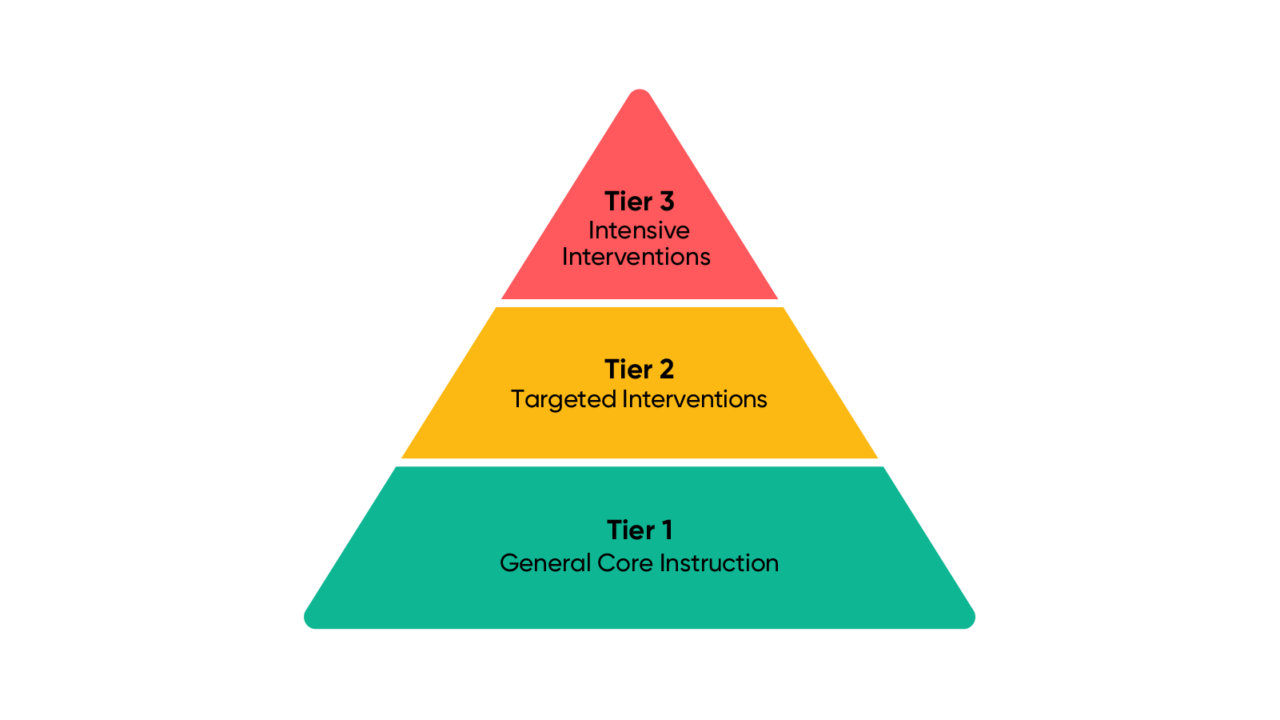
Tier 1 is the foundation. We refer to this as the Universal level. This is the classroom environment, practices and supports that all students receive in the classroom and throughout the school.
At Tier 1, teachers differentiate their approaches by proactively planning and implementing a variety of instructional methods matched to varying student skill needs within the classroom. As a school we offer a wide range of extra-curricular and elective options for our students and support them to engage and find their personal passions and a responsive pastoral care program. We also work to have clear and well understood expectations for behaviour and learning and the processes in place to support this.
We focus on implementing Quality Teaching and Learning and we are committed to improving our own teaching practices through developing our knowledge and skills in;
- Formative Assessment- Knowing what our students know before, during and after the learning.
- Differentiation - Responding to what our students know and adjusting our practice to support them to grow in their learning.
Tier 2 involves additional interventions that are provided with an increased level of intensity in addition to the universal strategies. These are for students who may also require additional learning, social or emotional supports.
We refer to this as the Targeted level. Tier 2 interventions usually involve small group programs and activities which allow for high levels of personalised learning and give support for specific skill building.
Tier 3 involves providing interventions for those students with the highest level of need and who require a holistic and case-management approach. We refer to this as the Intensive level.
Such interventions are tailored specifically to meet the needs of each student. Students receiving intensive interventions will be supported through the Student Wellbeing, Diversity or Gifted and Talented Team, who will provide evidence-based strategies and guidance for other staff across the school, manage parent/carer communications and provide high level academic/social support.
Students may move fluidly among the tiers as a result of their response to instruction and interventions. A student can move from Tier I to Tier 2 and back to Tier I within a relatively short period of time.
How do we use the RTI Model at Alfred Deakin High School?
We aim to ensure that students receive the types and levels of interventions needed in a timely manner. We do this through:
Our staff – working to ensure our staff have the support they need to deliver high quality teaching and learning in every classroom every day. This includes:
- Clear strategic and operational plans
- Clear expectations of practice
- Support through coaching and professional learning to improve practice
- Support of a collaborative, respectful and professional culture of high expectations and ongoing learning
Our Policies and Processes (in accordance with Safe Schools Framework, Gifted and Talented, Inclusion):
- School wide card agreement system
- Individual case management – ILPs, PBSPs, PLPs
- Interagency referral
- Targeted programs
Our Students
- Social and Emotional Learning program delivered through Pastoral Care
- Student Leadership and Voice
- Student Programs and Clubs
Our Families and Community
- Collaboration with student case management and support plans
- Family engagement - afternoon teas, meetings, exhibitions
- Community engagement - referrals, programs, presentations
Our Shared Values and Beliefs
- Respect
- Community
- Excellence
- Responsibility